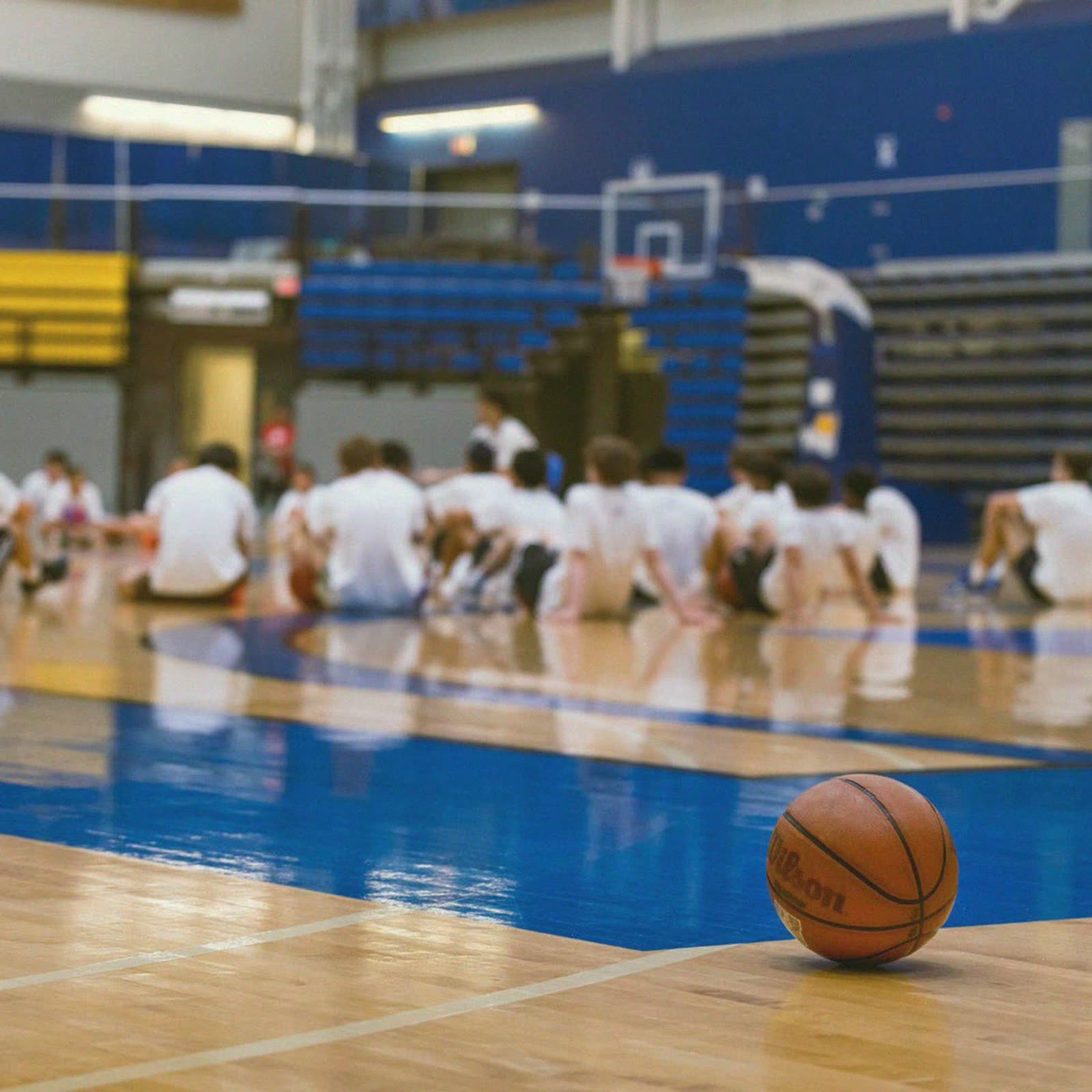
Stations, not lines: one assistant and 18 kids
Four stations of four or five, eight minutes each, one whistle to rotate. Your assistant and a parent each run one off a card, and you run none of them.
Four stations of four or five kids, eight minutes each, one whistle to rotate. Your assistant runs a station, a parent runs a station, and you run none of them. Eighteen kids and two adults is a floor plan problem before it is a discipline problem.
Lines are the floor plan most of us start with, because lines are what we remember from being coached. One ball, one basket, seventeen kids waiting. The two boys at the front get coached and the fifteen behind them are unsupervised, which is the whole thing in one sentence.
Why does standing in line turn into misbehaving?
Because a kid with nothing to do will find something to do, and what he finds is always louder than what you planned.
Watch the line sometime instead of watching the drill. The kid at the back goes first. He shoves somebody, he starts a side game with a loose ball, he sits down on the baseline. None of that is a bad kid. That is four minutes of nothing handed to a nine year old by an adult who thought he was running a drill.
Stations fix it by taking the waiting out. In a group of four with one ball, the longest a kid waits is three reps. Nobody at a station has four minutes to fill, so nobody fills it.
What does a four station gym actually look like?
Here is the layout I run with eighteen third and fourth grade boys in one half of a gym. Four stations, four or five kids each, eight minutes apiece.
| Station | Where on the floor | The drill | The one cue | Who runs it |
|---|---|---|---|---|
| 1 | Right side of the near basket | Form shooting from two feet, five spots, ten makes a spot | "Elbow under the ball" | Assistant |
| 2 | Baseline, cone every five feet | Dribble the cones down and back, weak hand on the way back | "Eyes up at the cone" | Parent |
| 3 | Far basket | Partner passing, chest then bounce, count to twenty without a drop | "Step into the pass" | Nobody, it runs itself |
| 4 | Center circle | Closeout and mirror, partners, no ball | "Short steps, hands up" | Nobody, it runs itself |
Two adults are standing on stations and two stations are running themselves, which is the only version of this that works when you have one assistant. Four eight minute stations plus the rotations and a water break lands around forty minutes of work. The age by age practice lengths are here if your team is younger or older than this one.
The same layout works in a volleyball gym: passing to a wall, partner setting, serving at a taped target on the wall, and footwork on the center line, with the net dividing three and four instead of the baskets.
How do you rotate 18 kids without losing four minutes?
One whistle, and the word clockwise.
- Number the floor, not the kids. A strip of tape with a 1, 2, 3 and 4 on it at each station. Kids find a number on the floor far faster than they remember a sentence you said eight minutes ago.
- One whistle means one thing. Not "come here," not "stop," not "listen up." On this night, one blast means move one station clockwise. If it also means huddle up, it means nothing.
- Say the next station out loud before you blow it. "Group at the far basket, you are going to the center circle." Ten seconds of that saves a minute of pointing.
- Balls stay at the station. Equipment never travels with a group. That is half of your lost time right there.
- Start the next station cold. No restatement of the drill from you, because the card at the station already has it, and the adult standing there already read it.
What goes on the station card?
Five lines on an index card, and nothing else. Anything longer and nobody reads it.
- The station number and where it stands.
- The drill name and one sentence of setup.
- The one cue, in quotation marks, written exactly as you want it said.
- The count. Ten makes, twenty passes, five trips. Never a number of minutes, because the whistle owns the minutes.
- A harder version and an easier version, one line each, for the kid who is bored and the kid who cannot do it yet.
A parent who has never coached will run a good station off that card. A parent who has to ask you what to do next will walk away from his station to do it, and now nineteen people are standing around.
What I ran with my team on a Tuesday
My first year with a basketball group, I ran a layup line for ten minutes because that is what every practice of my childhood opened with. Eighteen kids, one ball, one basket. By minute six I had two boys wrestling on the baseline and a kid asking to go to the bathroom who did not need to go to the bathroom. I was coaching two kids and refereeing sixteen.
The next week I taped numbers on the floor, wrote four cards in the truck in the parking lot, handed one to my assistant and one to a dad who had been standing by the door for three weeks, and ran eight minute stations. Same gym, same kids, same ninety degree night. I did not raise my voice once, and I cannot say that about any practice I ran the month before.
The dad at station two still runs it. He asked at the end whether he could have the card to keep.
What goes wrong in week one, and what fixes it?
Two things, and both of them will happen to you.
The first rotation takes four minutes. Nobody knows where clockwise is, two groups land at the same basket, and one kid stands in the middle of the gym looking at you. The fix is to walk the whole rotation once with no balls before station one begins. It costs you ninety seconds on night one and buys back three minutes a rotation for the rest of the season.
Nobody knows which group they are in. Kids rotate as a herd, and the herd grows. Name the groups before you start, say the names out loud, and point at where each group is standing. A group of four with a name holds together. Four kids who happen to be near each other do not.
By the third practice the rotation is under twenty seconds and you will stop thinking about it, which is the real reason to do this. The layout stops being the thing you manage and goes back to being the thing that holds the practice up. If you are still on your very first night with a new team, start with the names, one rule and two drills instead, and bring the stations in week two.
What are you doing while the stations run?
Nothing on a card, which is the point.
You float. You stand on the station that is going worst, teach for two minutes, then leave it. You watch the clock so nobody else has to. You take the kid who is coming apart out to the sideline for a minute and bring him back in, which you cannot do if you are feeding passes at station three.
A head coach running his own station is a coach with four stations and no supervision. The first time a ball goes into the hallway you will understand why that matters.
Where do the cards live?
Mine live in Cheat Code Teams so my assistant can pull up the station on his phone without me, and a photo of the whiteboard would do the same job. An index card in a back pocket works too, as long as the cue and the count are actually written on it.
The format is not the hard part. The hard part is deciding on Sunday what the four stations are, because a station you invent in the gym at 6:12 is a line with extra steps.
Questions coaches also ask
- How many kids should be at one station?
- Four or five. At six a line starts forming inside the station, and at three you need five stations and a fourth adult you do not have. With eighteen kids, four groups of four or five is the shape that keeps every kid within three reps of his next turn.
- What if only one parent stays to help?
- Run three stations of six and make one of them self-running: wall work, partner mirroring, footwork on a line. A drill that explains itself in one sentence and needs no feeding does not need an adult standing on it. You still float, and your assistant still gets a card.
- How long should each station run?
- Eight minutes for 7 to 10 year olds, ten or twelve for middle school. Watch the last rep instead of the clock. If rep nine looks worse than rep one, that station was two minutes too long and everybody in the gym already knew it.
- Do stations work in a gym with one basket?
- Yes, and that is where they help most. Only one of your four stations needs the rim. The other three are partner passing, dribbling between cones on the baseline, and closeout footwork at the center circle, none of which need a hoop at all.
Nobody gets skipped
Nobody gets skipped. Sign up as a coach at cheatcodecoaching.app, then download Cheat Code Teams on the App Store.
Want to swap scripts and stories with other volunteer coaches? The Cheat Code Coaching community on Skool is free to join.