How to run your first youth practice: a 60-minute plan
Get there early, learn names in the first eight minutes, warm up with a game instead of a lap, teach one skill through games, then play 3v3 and huddle.
Here's what I believe about your first youth practice. Have a plan. Write it down, stick it on a clipboard, whatever works. Then expect it to go sideways, because it will. A coach with no plan isn't more relaxed. He's making it up in front of twelve kids.
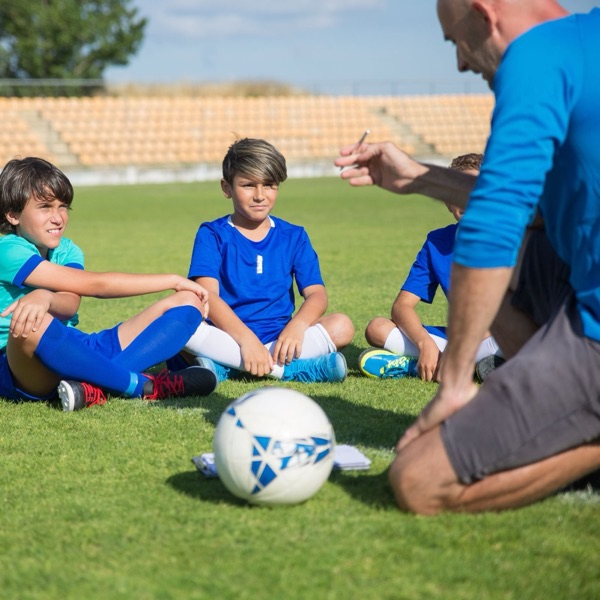
So say it's the first night. A dozen kids are standing in a half circle on the grass, nobody's saying anything, and you've got a bag of cones and about an hour. Below is a 60-minute plan for that. It works for pretty much any sport with a ball and some cones.
The practice you remember
If you're like most new coaches, you run the practice you remember. A lap, a stretch circle, then a drill with a line, because that's what a drill looks like. It feels like practice.
But somebody put activity monitors on kids. In a study of 28 flag football practices with 111 children ages 5 to 11, whole practices averaged 34% of time in moderate-to-vigorous activity. Warm-up and gameplay segments were up around 54%. The segments where coaches taught sport skills sat near 32%.
So the teaching was one of the least active parts of the night. It's one sport, so I'd call it a pattern, not a law. Positive Coaching Alliance's tips for new coaches are blunt about it: at the younger ages, avoid lines.
If standing around is the cost, how do you teach anything? Games. Most of this plan is games.
The hour, roughly
Treat this clock as a starting shape to bend, not a contract. As tired as you are after work... as little time as you had to plan it... you're still better off with this on a card in your pocket than with nothing.
| Minutes | Block | What happens |
|---|---|---|
| 0-8 | Arrival and names | Each child grabs equipment and plays freely while you learn names |
| 8-12 | Opening huddle | Thumbs check-in, one focus, one freeze signal |
| 12-22 | Movement game | Tag-style game, everyone moving the whole time |
| 22-24 | Water and demo | Show the skill once, quickly |
| 24-39 | Skill games | Two 7-minute activities in groups of 3 or 4 |
| 39-41 | Water and teams | Split into small-sided teams |
| 41-54 | Small-sided game | 3v3 or 4v4 in short rounds |
| 54-60 | Cooldown and closing huddle | Walk and shake out, shout-outs, next practice |
Get there fifteen minutes early. Set up two small play areas with cones and put a ball, bat, or racket at every spot. Kids who walk into something to do usually don't wander off, and you get those first eight minutes to learn names. PCA's guide says to learn the names players prefer and use them often.
Warm up with a game, not a lap. Tag with equipment in hand does it.
The skill block is where new coaches get greedy (we all do). PCA's advice is to pick one or two areas of focus, and honestly I'd stick with one on night one. Show it once in under a minute, then run two 7-minute activities. Keep directions short too: give 1-2 instructions at a time. If a kid is waiting more than a few seconds, add a ball or split the group. Stations beat lines every time with this age.
The small-sided game is the payoff. An AYSO resource shared by PCA says fewer players on a smaller field means more touches and more involvement. Run 3-minute rounds and rotate teams.
Here's where it gets gray. With 7-year-olds, I'd skip the scoreboard talk and swap players on a timer, since Project Play recommends equal playing time through at least age 12. With a travel team of 13-year-olds, that guidance stops short, so talk to your league.
What to say in the first ten seconds
Back to the half circle. Your first minute tells them what kind of place this is. If your kids are 5 to 8, try a loud one. You'll feel silly. Do it anyway, because little kids don't care how you look.
`` COACH (big voice): Who's ready to run around like crazy people?! KIDS: Me! COACH: I can't hear you! Who's ready?! KIDS: ME! COACH: Can you run like a cheetah?! (Kids: Yes!) Can you freeze like a popsicle?! (Kids: Yes!) COACH: Let's find out. Everybody jog in place... FREEZE! Whoa. Best popsicles I've ever seen. COACH: That's our signal. When I yell "Freeze," you stop and look at me. Can you do that for me? ``
If you're not a loud person, a quieter version still works. Whisper it and make them lean in. And if your group is 11 or older, skip all of it. They'll let you know.
Then get down on a knee (PCA describes getting down on a knee to get to their level) and settle them with a four-minute huddle: a thumbs check-in (up, sideways, down), one focus for the night, and the freeze signal. With 12- and 13-year-olds, swap the thumbs for "rate your day one to five," or skip it.
The closing huddle runs about three minutes. PCA recommends ending on a positive note, and asking who saw a teammate do something well. If the night went sideways, find the true thing anyway. Kids can smell a fake compliment from across the field.
One technique to try, not from a study: ask the same simple question every practice and let them answer. Are we perfect? They'll say no. Then, what can we do to keep getting better? Short on time? Skip the cheer, not this.
`` Bring it in and sit down. Who saw a teammate do something great today? (Take two or three answers.) I saw [one specific thing]. Are we perfect? (They'll yell "Nooo!") So what can we do to keep getting better? (Take two or three answers.) Next practice is [day, time, place]. Bring water. Cheer on three. ``
The night the plan falls apart
Somewhere in the first few practices, something's going to knock the plan sideways. Say it's minute twenty-two, the tag game is loud and happy, and nobody wants water. Let them run. Cut the second skill game instead. That's the whole reason you wrote a plan: so you know what you're bending away from.
But what if eleven kids show up?
Say twice as many kids show up as you expected. Split into two small games side by side and ask a parent to run the second group. With an odd number, make one game 3v3 and the other 4v4 and rotate who plays where.
You'll be tempted to give your best players extra minutes, because the games look better. The cost is the quiet kid on the sideline figuring out where he ranks on night one. I'd think hard about that before doing it.
Follow your league's rules on how many adults have to be at practice, and ask a parent to stay and help. PCA suggests inviting them directly. If you ever have a concern about a child's safety, tell your league and report it through the U.S. Center for SafeSport.
Next practice, check around minute twelve. Nobody's looking at you. A dozen kids are chasing each other around cones you set out before they showed up, and the half circle is gone. That's how you know the first ten seconds worked.
Sources
- Physical activity patterns across time-segmented youth sport flag football practice (PubMed)
- 16 Tips for the First Time Coach (Positive Coaching Alliance)
- Tips for designing and running a practice (Positive Coaching Alliance)
- Small-Sided Soccer For Youth Players (AYSO, via Positive Coaching Alliance)
- 8 Strategies from Project Play to Build Kids into Athletes for Life (Aspen Institute Project Play, via health.gov)
- U.S. Center for SafeSport
Questions coaches also ask
- How early should I get to my first practice?
- Fifteen minutes. Set up two small play areas with cones and put a ball, bat or racket at every spot. Kids who walk into something to do usually do not wander off, and those first eight minutes are when you learn names. Use the names they prefer and use them often.
- Should kids run a lap to warm up?
- No. Warm up with a game. Tag with the ball in hand does the job, and every kid is moving the whole time. A study of flag football practices found the warm-up and game segments were the most active parts of the night, and the skill teaching was one of the least. Lines are the cost.
- How many skills should I teach on night one?
- One. New coaches get greedy here, and I have done it too. Show the skill once in under a minute, then run two 7-minute games in groups of three or four. Give one or two instructions at a time. If a kid is waiting more than a few seconds, add a ball or split the group.
- What if twice as many kids show up as I planned for?
- Split into two small games side by side and ask a parent to run the second one. With an odd number, make one game 3v3 and the other 4v4 and rotate who plays where. Resist giving your best players extra minutes. The quiet kid on the sideline is figuring out where he ranks on night one.
Nobody gets skipped
Nobody gets skipped. Sign up as a coach at cheatcodecoaching.app, then download Cheat Code Teams on the App Store.
Want to swap scripts and stories with other volunteer coaches? The Cheat Code Coaching community on Skool is free to join.